Careful with that door. Don’t slam –
you might trap a little lurker.
They slip in quiet, just off the edge
of vision, fold their powdery wings
and wait. Lovers of thresholds.
Watching. Wanting to drink
from the wellspring of your days.
Tiny universes of emptiness
baffled by the light. So much pain
in the corners of this room.
Leave a window open. Please.
Let them flutter round the lamp.
Little ghosts, come in. I have left you
nectar, honey, milk in china saucers.
Little ghosts, I want to feed you
though I cannot feed myself.
—
We haven’t been alone this summer. You might have thought the ferocious heat that some of us have been hiding from was precision built to force us apart from other bodies, creatures. Not another source of warmth! I am leaving you for now, my cat has said often in the last few months; I do not need you to raise my temperature.
But of course, this has been a golden age for some insects. As I type, a six-legged creature I can’t identify – a damselfly maybe – is hanging out on the window in my study, indecisive in whether it wants to come in properly, land on my keyboard, or disappear back out towards the three red roses in bloom that are somehow clinging on to colour, life.
In a lot of the days over the last few weeks I have felt that I am in some sort of Mexican standoff with houseflies. Or rather a fly. One, persistent chap, day after day – or more accurate to say, a new chap, the next day. Have they ever had such a good time, a rambunctious time? The Guardian article on the ‘plague’ that many homes have experienced also felt like a bit of a soft rebrand: the Big Fly brand strategy is eyeing up the path Cute Bee has taken, and fancies some of that repositioning action. Not as a nausea-inducing threat, but a soft, natural helpmeet.
Not that Rachael Davey’s ‘There is so much longing at the edges of this room’ is about flies per se. I suspect another summer I might read it and think it is another insect being hymned here. Lucky them to have such a hymn. To have such couplets of kindness and grace that say: you are no threat, bade ye welcome.
And it is a repositioning, for me at least, a person of the city that is scared by the words ‘verdant’, ‘wildlife’ and ‘lush’, to think that an insect might just want to make friends, “Wanting to drink / from the wellspring of your days.” Yes, yes we are all connected, but we – I – struggle to remember that that applies to much to the ugly species as well as the pretty ones.
There is something here as well that suggests if a relationship between human and insect can be established, the ‘I’ figure might attain some sense of, if not salvation, maybe an absolution of a sin. I suppose flies being drawn to the dirty is analogous to the “pain / in the corners of this room.”
I might disagree that they are “Tiny universes of emptiness” though. Ghosts aren’t empty – which these flies most likely are of course, if we take the long (and longing) reincarnation view – they’re restless memories that don’t know how and where to settle. Incomplete pictures, inevitably “baffled by the light”.
Mostly though this poem is a moment of wonder, capturing an everyday moment of wonder that we should take as being special. That we share space and time with anything at all is a miracle.
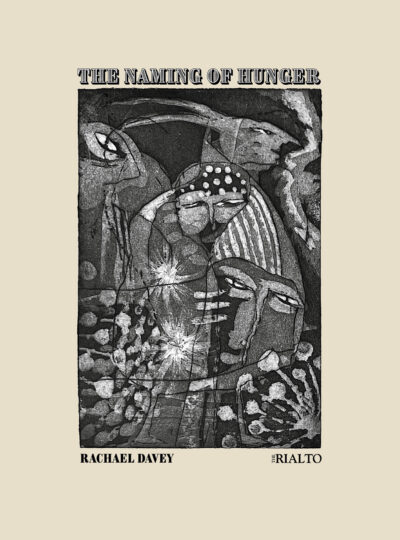
‘There is so much longing at the edges of this room’ can be found in Rachael Davey’s pamphlet, The Naming of Hunger, available from The Rialto.