THE RIALTO MIDWINTER NEWSLETTER: PART 2
An error. We are, of course, publishing three new pamphlets. The one I forgot to mention in Part 1 of the Newsletter is John Whale’s, Wayward Observations.
As to What’s in R103, here is the list of poets included: Juliet Antill, Chris Campbell, Karan Chambers, Michael Conley, Rachel Curzon, Kitty Donnelly, Christina Dunhill, Mave Fellowes, Billy Fenton, Matt Gilbert, Michael Greavy, Matt Haw, Matt Howard, Glenn Hubbard, Nicky Kippax, Michael Laskey, Anna Lewis, Hannah Lowe, Iain Macdonald, Jenny McRobert, Sarah Mnatzaganian, John Mole, Helen Mort, Eliza O’Toole, Vic Pickup, Thea Smiley, Martin Smith, M Stasiak, Travis Stephens, Laura Varnam, Tony Vowles, Max Wallis, Heidi Williamson, Jackie Wills, Alice Rowena Wilson, Jerrold Yam, and Cliff Yates. In addition there are poems from the three winners of the Nature and Place Competition (2024/25), Wendelin Law, Victoria Spires, Rosamund Taylor. And there’s Helen Mort’s Judges Report.
Most of these contributions arrived via Submittable. There are two poets who sent their poetry by post, also two poets from USA, but their contributions were of poems found on Submittable. The notable exceptions, apart from poems from the Competition, are poems by Hannah Lowe and by Helen Mort.
Helen read her poem In Qeqertarsuaq at the celebration event, at CCI in Cambridge, for the Competition winners. Helen writes that she,
‘first visited Greenland (East Greenland, Kulusuk) in 2016 on an exploratory mountaineering trip which led to the creation of a multimedia piece called ‘The Singing Glacier’ with composer Bill Carslake and a pamphlet of the same name with Hercules Editions. Since 2023, she has been working with quaternary scientists Dr Kathryn Adamson and Dr Iestyn Barr on the ‘Landscapes of Change’ project in different communities in Greenland, combining scientific data acquisition (analysing lake sediment samples) to map the effects of climate change with creative writing work in schools, a postcard project between teenagers in Greenland and the UK which she facilitated. The team worked in Narsaq and most recently in Disko Bay where this poem is set. She was resident at the Arctic Station in Qequertarsuaq in Spring 2025 and took part in fieldwork on the ice as well as working with students at the school. During her stay, she started working on this poem to examine the problematic nature of the tourist-observer or even the observer-artist dynamic in Greenland at a time of political as well as environmental uncertainty.’
Uncertainty about Greenland has increased considerably recently.
I was aware that when I began reading for 103 I was looking out for poets who were new to me. I’m not sure how successful I was in this quest as many poets who have been in the magazine before sent us poems that I couldn’t say no to. However there is one poet who is entirely new to this and other magazines and that is Alice Rowena Wilson whose accomplished poem ‘Royal Museum of the Fine Arts of Belgium’ is her first published poem. I particularly like the way the use of the long lines evokes the not very focused wandering about in cities that groups of school or college students experience, and how the long lines enable her to convey the shock of recognition at the heart of the poem by the contrasting use of short lines and single word lines. It works. Which is something I become more and more certain is the finest thing to be said about any poem.
And here is another poem from R103 that works.
YOU SAY HAPPY IS NOT EVEN A THING
But outside the scream of a swift
scything in from Africa, beyond
a lark pouring down his song
raining it down, a pelt of joy
bouncing, breaking, plashing
and the sparrows shouting now!
now! and the tits titting about
in the overgrown roses, shrilling
their small news, the click, whirr,
buzz of starling on phone-wire,
and passing goldfinch scattering
silver pins, rooks murmuring
in the sycamore, a thrush
idly turning over a phrase, and
beneath it all, your sleeping breath.
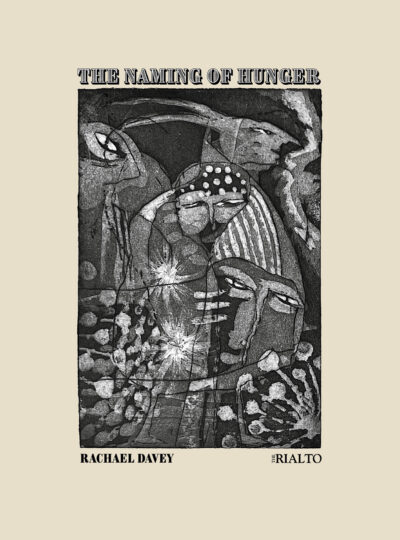
Rachael Davey
The key word in this poem is the last one, ‘breath’. And the key action is the breathless way the poem tumbles through the first two stanzas (all those words ending in ‘ing’), spills into the last stanza, slows itself down, and arrives at the balanced pause of the last line (‘beneath’… ‘breath’). The sheer energy of the life celebrated more than answers the scepticism of the title, whose introspection is overbalanced by all the accurately observed and accurately reported ‘outside’. It’s a love poem. What’s more loving than the trust shown by sleeping in the presence of another being?
Of course you can undermine the poem by talking about its anthropomorphism: a ‘scream’ is something humans do, no matter how ‘like’ a scream the noise a swift makes is, birds can’t be ‘pouring’ their sounds out, only humans pour stuff (no matter how much the lip of a jug looks like the lower mandible of a beak). Etc., etc. But what would be the point of such a deconstruction? The ability to identify with other life forms, both emotionally and linguistically, is part of the joy of life. I spent a lot of time arguing, in younger days, with persons who had ‘done’ philosophy, about their belief in the non-existence of altruism. I think the realisation of the commonality we share with other creatures is a blessing.
I like this poem, and it works for me. I’d like to note the importance of the letter s, which occurs 26 times, the balance of ‘scything’ (first stanza) and ‘sycamore’ (last stanza), the power of ‘But’ which stands at the start of the first line (a bit like the ‘Hwæt’ at the start of Beowulf). Once upon a time I was looking after a couple of goats while our vicar (their owner) was holidaying: I went out to the field to check on them (noting how blue their eyes were in the torchlight) turned away and began to walk back to the house. Fortunately the running goat had reached the end of its tether when its butting head connected with my bum and threw me on my face. Such is the power of ‘But’.
There are many other poems that work in R103. From memory, Christina Dunhill’s poems about adolescence, Kitty Donnelly’s poem about friendship and alliance, Hannah Lowe’s shared humanity, Sarah Mnatzaganian on the miracle of human babies: from a quick flick through the magazine, Matt Haw’s elegy, Martin Smith’s poem about writing a poem, Karan Chambers, Mave Fellowes, many others…
There’s one poem that still puzzles me. It’s ‘When the Fieldfares’ by Matt Gilbert, a poem that creates, for me, an extraordinary meditational stillness. I need to spend more time with it to find out how it does this.
OTHER PAMPHLETS
Two poets, both members of The Rialto Advisory Board, had pamphlets published last year. Let’s hope they both get entered for the upcoming Michael Marks Awards.
Colin Hughes has been associated with The Rialto since he won the 2013 Nature and Place Poetry Competition, judged by Ruth Padel.
Colin’s pamphlet Make No Mistake is published by the excellent Cinnamon Press under their Leaf by Leaf Imprint ( ISBN 9 781788 648646 ). Very tidily designed it includes twenty six poems that ably demonstrate the poet’s intelligent eye for Nature and Human Nature.
Here’s a sample poem, a love poem, that includes and explains the title of the pamphlet.
LOOK UP
When you look up ‘black-winged kite’
the bird guide asserts: ‘Unmistakable.’
With a full-stop, believe it or not.
How useful is that? Dry wit or rhetoric,
when you look vertically up
and spot the neatly soaring hawk,
before you know what it is you know
what it’s not: that it’s never to be mistaken,
it’s too perfect against the hot, blue Andalusian heaven –
all we can do is step round the wall
to take a better, neck-rending look,
hand in hand: be sure to make no mistake.
Colin Hughes
Matt Howard’s pamphlet is called Resident and it is published by the Yorkshire Sculpture Park to celebrate the year that Matt spent as poet in residence. The ISBN number is 978 1 908432 68 1, the residency was supported by the TS Eliot Foundation, and as well as Matt’s sixteen poems the pamphlet is full of Emily Ryalls evocative black and white photographs.
I’ve chosen this short sample poem because it illustrates something I think Matt is particularly good at, specific observation, accurately communicated.
18th MAY 2025
Bridge Royd Wood
Here’s an early installation of summer –
where wood anemone are long since over,
wild garlic sweats, yellowy, fading,
and the great drift of bluebells spindles
to a paler, cracked, parched-lip blue.
A thick grit of aphids crawls undersides
of leaves slicked in an ooze of honeydew.
One dandelion towers above the rest,
a single stem, neither hand nor pendulum,
its clock head full of seeds,
while there, on the edge of hearing,
a goldcrest, forty or more feet above
in the closed, heavy green canopy
forges ringlets of breath.
Matt Howard
The listing of species reminds me of John Clare’s work. Teaching people to see and hear is a great gift; to pay attention to one another and to the world around us, is all part of the function of poetry.
Readers will have noticed that here is another poem ending with ‘breath’.
I don’t know where you can buy these pamphlets but your local bookshop should be able to find them for you via the ISBNs.
Michael Mackmin
PS We will be opening Submittable for poems to be considered for R104 later this month.